Why most university-industry R&D partnerships fail from infrastructure, not science
Andrew T. Flowers ·
I have spent 18 years across the R&D-to-commercialization lifecycle, in more roles than most: chemical engineer, principal investigator, business developer, contract negotiator, and portfolio manager for tens of millions of dollars in R&D investment bridging universities, corporations and startups, national labs, and government partners. In all that time, I never saw a collaboration fail because the science was bad.
Collaborations fail because the agreement takes nine months to negotiate and the funding window closes. Because the researcher and the program manager each think the other owns the regulatory testing. Because "deliverable" means a validated prototype to one side and a published paper to the other, and nobody notices until the first annual review. Because the status of a $2M project lives in one postdoc's inbox.
The science works, but the infrastructure fails.
That distinction matters, because almost everything written about improving university-industry collaboration focuses on the inputs: better technology, stronger faculty, more funding. The evidence points somewhere else. Partnerships underperform for structural and operational reasons that are well documented, broadly shared across organizations, and, in most cases, fixable with tools that already exist.
Before you read on: if you want to know where your own collaboration stands, we built a free Collaboration Readiness Assessment that scores a partnership across six structural dimensions. It pairs well with this article.
The gap is structural, and enormous
Let's start with the macro picture. According to the National Science Board's Science and Engineering Indicators, the business sector funded about 75% of United States R&D in 2021. Yet less than 1% of business R&D spending goes to university research: in 2023, U.S. businesses spent $722 billion on R&D and funded $6.2 billion of research at universities (NCSES, 2023 data). Universities performed nearly $118 billion of research in fiscal year 2024, per the NCSES Higher Education R&D Survey, and businesses funded only around 5% of it.
Read those numbers together and the picture becomes clear. American companies fund three quarters of the nation's R&D. American universities run one of the largest research enterprises on earth. And the pipe connecting them carries a trickle.
I don't believe companies think they have no use for university science. The explanation that fits the evidence is friction: the partnerships are hard to form, hard to run, and some don't even know how to find one.
Frictions preventing a successful R&D partnership
Three independent bodies of evidence converge on the same answer.
Misalignment tops the barrier list. When the Association of Public and Land-grant Universities interviewed university and industry leaders for its 2021 report, Driving U.S. Competitiveness Through Improved University-Industry Partnerships, the most frequently cited barrier was misalignment of goals and incentives. The companion barriers are just as telling: misunderstandings about facilities and administrative rates, faculty unfamiliarity with industry contracting, and a shortage of personnel experienced in negotiating university-industry relationships. Notice what is absent from that list: research quality. Every top barrier is about the bureaucracy between the organizations.
Agreements take months, and each side experiences the delay differently. In a 2022 survey of 64 member representatives, the University-Industry Demonstration Partnership asked how long sponsored research agreements take to complete. About 44% said three to six months, and about 5% said more than a year. The detail I find most diagnostic: 54% of industry respondents said agreements typically take seven months or more, while most university respondents put the figure at six months or less. The two sides of the same negotiation cannot even agree on how long the negotiation takes. That is an expectations gap measured in calendar months, before any research has begun.
Practitioners report the same pattern from the inside. In 2024, I presented research at the R&D Management Conference in Stockholm exploring how university-industry collaborations operate day to day (Flowers and Roadman, 2024). We surveyed faculty at five large R1 research universities, with the most commonly cited collaboration challenges being intellectual property disputes and contract negotiation breakdowns. Faculty found partners mainly through personal networks rather than any systematic process. And the digital tools holding their collaborations together were generic: email, spreadsheets, shared drives, none of them built for multi-party research projects that cross institutional boundaries.
Strategic-alliances literature predicted all of this
None of this would surprise anyone who is familiar with strategic-alliances research, because these patterns were cataloged in the corporate world decades ago.
Kale and Singh, writing in the Academy of Management Perspectives in 2009, documented what they call the alliance paradox: firms keep forming alliances even though many underperform, with an estimated 30% to 70% failing to meet their parent companies' goals. The differentiator between firms that beat those odds and firms that do not is unglamorous. It is whether the firm built a dedicated capability for managing alliances: codified processes, accumulated lessons, someone whose job it is. Firms with a dedicated alliance-management function succeed about 70% of the time, compared with about 40% for firms without one (Kale and Singh, 2009). Thirty percentage points of success rate, attributable to management infrastructure rather than to deal selection.
University-industry partnerships are strategic alliances with extra complications: two incompatible incentive systems, two different calendars, two definitions of success, and a negotiation that runs through technology transfer offices and procurement departments. If 30% to 70% of general-purpose alliances fall short of their goals, and the firms without a dedicated alliance function fare worst, there is no reason to expect cross-sector research alliances to do better with improvisation.
Midpoint check: our free Collaboration Readiness Assessment scores the six dimensions underneath everything this article describes: governance, culture, processes, resources, track record, and network. No cost, specific recommendations.
A framework for the whole project lifecycle, not one slice of it
The practical problem with most partnership advice is that it covers one phase. Partner-search tools stop at the introduction. Contract guides stop at the signature. Project-management methods assume a single organization. Each is useful; none sees the whole.
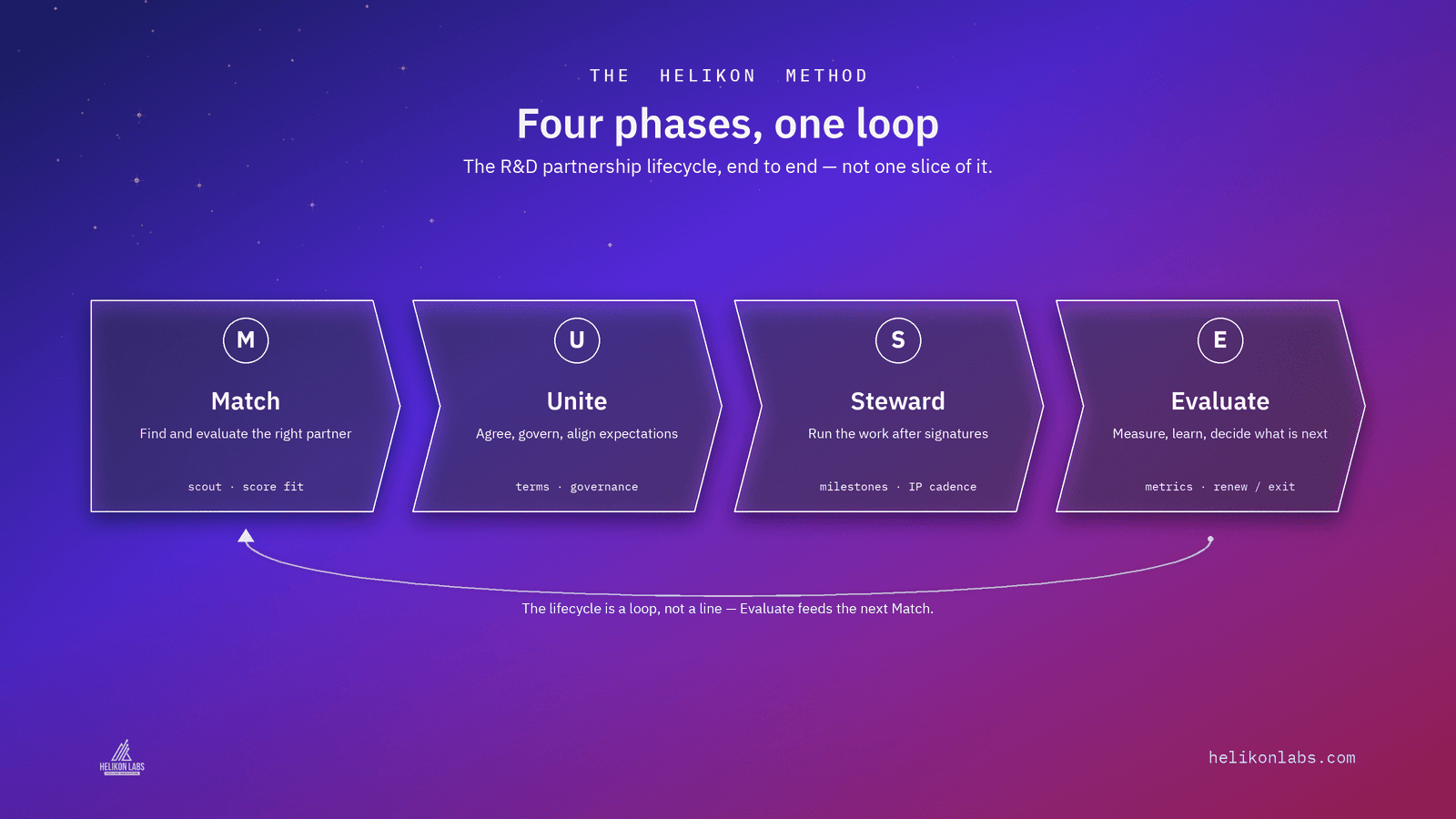
At Helikon Labs we organize the full lifecycle as four phases. We call it the Helikon Method, and the phases form the mnemonic MUSE: Match, Unite, Steward, Evaluate. (The name is a nod to the ancient Greek Muses of Mount Helikon, where knowledge crossed the boundaries of rival city-states. The boundary-crossing is the point.)
Match: partner identification and evaluation. The failure mode here is selection by proximity: the partner you know rather than the partner whose capabilities, incentives, and working style fit the work. Our primary research found faculty matching through personal networks almost exclusively. Networks are a fine place to start and a poor place to stop. The fix is a structured evaluation: score candidate partners on capability fit and on compatibility, and do it before commitment, before you're locked in.
Unite: agreement, governance, and expectations. This is where the UIDP's months-long negotiation timelines and APLU's misalignment findings live. The work of Unite is to make the implicit explicit: what "deliverable" means, what "success" means this year, who owns what, who decides what, how often the partners actually talk. Most of this does not belong in the legal agreement. It belongs in a governance design the partners build together, which the lawyers then codify.
Steward: execution after the signatures. The longest phase and the least managed. Multi-party research projects have uncertain timelines, deliverables split across organizations, and a permanent tension between publication and protection. Stewarding means a real operating cadence: milestone tracking both sides can see, IP decisions made on schedule rather than at crisis, an escalation path that gets used before resentment compounds.
Evaluate: measurement, learning, and what happens next. Partnerships that cannot demonstrate their value get defunded in the next budget cycle, deservedly or not. Evaluation means agreeing up front what evidence will count, measuring against it, and making the renew-redesign-exit decision deliberately. What you learn here is your advantage in the next Match, which is why the phases form a loop rather than a line.
What to do now
A framework is only useful if it changes what you do this week. Here is a five-question diagnostic you can run on any active collaboration, drawn from the assessment instruments we use in engagements:
- Could both partners, asked separately, state this year's definition of success in one sentence, and would the sentences match?
- Is there a written map of who is responsible for each major work stream, or does responsibility live in assumptions?
- Can either side see current project status without emailing someone and waiting?
- Is there a decision the partnership has been deferring for more than a month because no one is sure who gets to make it?
- If your key counterpart left tomorrow, would the collaboration's institutional memory leave with them?
Two or more uncomfortable answers means the infrastructure needs work now, before something breaks later. In my experience managing a portfolio, every collaboration that later went sideways would have failed at least two or three of these questions, months before the trouble announced itself.
The encouraging part of everything above: none of it requires better science, more budget, or different people. Misalignment, slow agreements, ungoverned execution, and unmeasured outcomes are process failures, and process failures have process fixes. A 30 percent success gap is at stake for developing your partnership infrastructure.
If you want a structured version of this diagnostic, start with the free Collaboration Readiness Assessment. It scores your collaboration across six dimensions and ends with specific recommendations for whatever needs attention first.
Sources
- National Science Board. 2024. Science and Engineering Indicators 2024: The State of U.S. Science and Engineering (NSB-2024-3), "U.S. and Global R&D." ncses.nsf.gov/pubs/nsb20243
- NCSES. 2025. "Business R&D Performance in the United States Increases to $722 Billion in 2023" (NSF 25-353). ncses.nsf.gov/pubs/nsf25353
- NCSES. 2024. "Higher Education R&D Expenditures Increased 11.2%, Exceeded $108 Billion in FY 2023" (NSF 25-313). ncses.nsf.gov/pubs/nsf25313
- NCSES. 2026. "Universities Report 8.1% Growth in R&D Expenditures in FY 2024, Reaching Over $117 Billion" (NSF 26-305). ncses.nsf.gov/pubs/nsf26305
- Association of Public and Land-grant Universities. 2021. Driving U.S. Competitiveness Through Improved University-Industry Partnerships. aplu.org
- UIDP. 2022. "1-Minute Survey: Time to Agreement for U-I Sponsored Research" (n=64). uidp.org
- Kale, P., and H. Singh. 2009. "Managing Strategic Alliances: What Do We Know Now, and Where Do We Go From Here?" Academy of Management Perspectives 23 (3): 45–62. doi.org/10.5465/amp.2009.43479263
- Singh, H. 2011. "The Key to Successful Alliances: Developing Firm-level Capability." Wharton at Work. executiveeducation.wharton.upenn.edu
- Flowers and Roadman. 2024. "Catalyzing Strategic Partnerships: Digital Transformation of University–Industry Collaborations for Synchronized Innovation." R&D Management Conference, Stockholm.