
How to evaluate a research partner: fit beats prestige
Andrew T. Flowers ·
Ask any research group how they found their most recent project partner and you'll usually hear a story about a person, not a process. A faculty member knew someone from a conference. An alumnus made an introduction. A company emailed the one professor whose paper they'd read.
Our primary research found exactly this pattern: faculty in our exploratory survey matched with industry partners most often through personal and professional connections, more than through any formal or systematic route. No comparative evaluation against alternatives, no scoring. The network produces a candidate, and the candidate becomes the partner.
The lesson here is not that "networks are bad." Networks are how trust starts, and the evidence says prior relationships help collaborations succeed. The problem is what happens after the introduction. Nothing. The candidate the network produced is rarely evaluated against any criteria at all, let alone against alternatives. Selection by introduction, commitment by default.
The partner-selection literature has been clear for decades about what that skips, and what it costs.
A place to start: before you can evaluate a partner well, your own side has to be set up for it. The free Collaboration Readiness Assessment scores your institution across six readiness dimensions, including whether you have a documented intake-and-evaluation process and the network to source candidates in the first place. Scored, free. The rest of this article explains what to score in a partner, and why.
Two kinds of fit, and most check only one
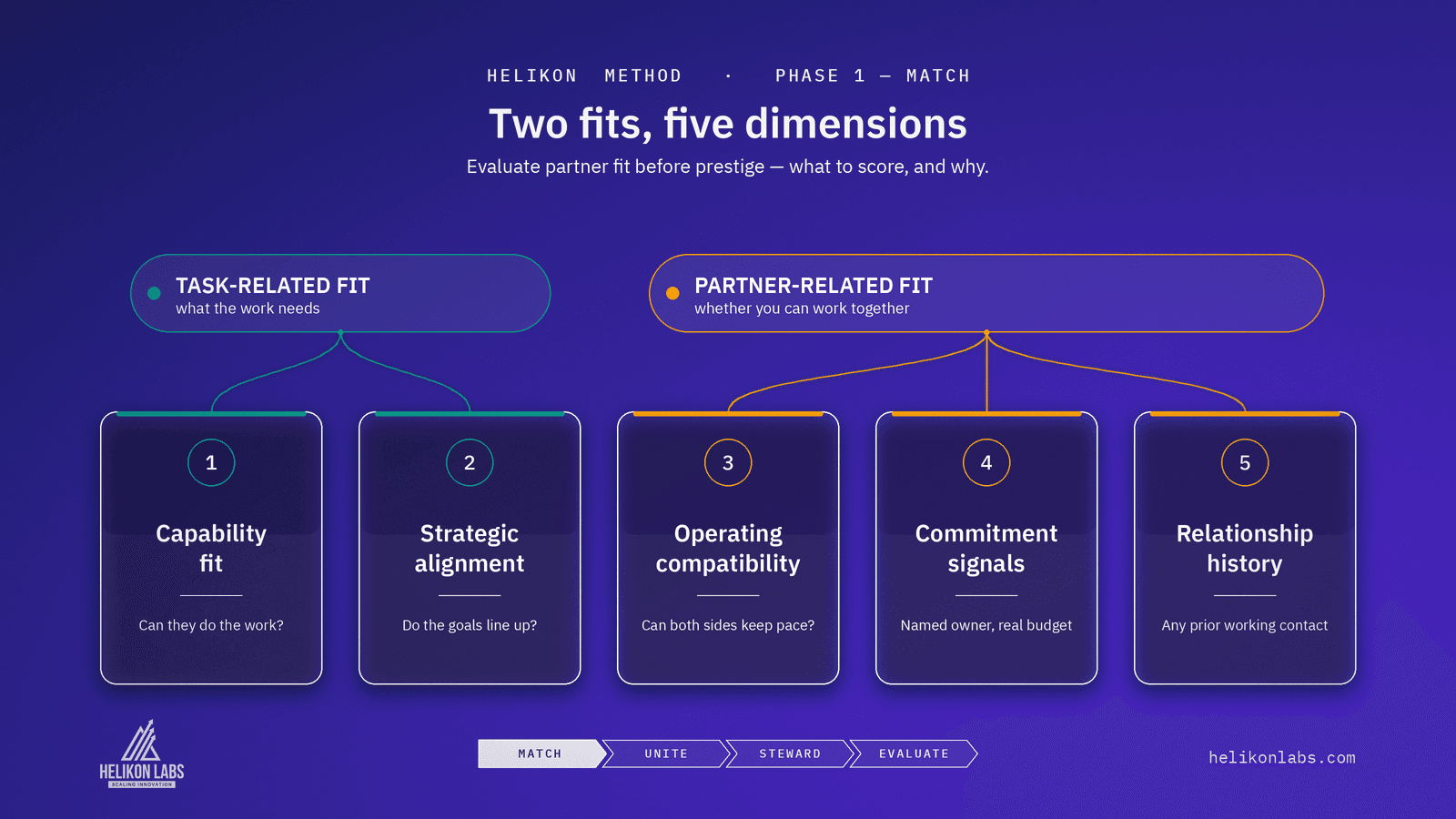
The foundational distinction in partner-selection research comes from J. Michael Geringer's 1991 study of joint ventures in the Journal of International Business Studies: selection criteria divide into task-related and partner-related.
Task-related criteria are about the work. Does this organization have the technical capability, the equipment, the data, the market access, the regulatory experience the project needs? Partner-related criteria are about the working relationship, compatible timelines, compatible decision-making cultures, commitment at the right organizational level, incentives that point the same direction as yours.
Here's the pattern I've seen across 18 years in industrial R&D, and the reason this article has its title: almost everyone evaluates task fit, almost no one evaluates partner fit, and the partnerships that fail usually fail for lack of partner fit.
Task fit is what my introduction already established. The company emailed that professor because of their paper. The capability question answered itself. What nobody scored is whether a tenure-track lab running on a publication clock can serve a product team running on a launch window. Whether the company's decision cycle (quarterly, committee-bound) can keep pace with a graduate student's experiment cycle. Whether either side has someone with the time and authority to manage the relationship at all.
Those are knowable things. They're simply never asked.
What the evidence says predicts success
Three findings from the research literature to internalize before your next partner decision:
Barriers come in two kinds, and contracts are only one. Bruneel, D'Este and Salter (2010), studying university-industry collaboration barriers in Research Policy, distinguish orientation-related barriers (the two sides want different things on different clocks, publication versus secrecy, exploration versus deadline) from transaction-related barriers (IP terms, contracting, administration). Their finding with the most practical force: prior collaboration experience and trust between the parties lower the barriers. Trust built across repeated contact does what no contract clause can. The selection implication is that a partner with whom you have any working history, even a small project, carries materially lower formation risk than a prestigious stranger. Weight that in the evaluation, explicitly.
Commitment and prior links predict success. Mora-Valentín, Montoro-Sánchez and Guerras-Martín (2004), analyzing 800 cooperative agreements between Spanish firms and research organizations in Research Policy, found that for firms, success depended on commitment, previous links, clearly defined objectives and how conflict was handled. The partner everyone wants on their press release and the partner who returns emails within a day are different selection problems, and the factors that study measured belong to the second.
The relationship form is itself a choice. Dyer, Kale and Singh's 2004 Harvard Business Review article, "When to Ally and When to Acquire", makes a point that transfers directly to research partnerships: organizations default to a single collaboration form out of habit, when the right form depends on the type of interdependence the work requires. Before scoring partners, ask whether this needs to be a multi-year strategic alliance at all, or whether a service agreement, a consortium membership, or a licensing arrangement gets the outcome at the right level of collaboration. The biggest selection error is sometimes selecting a partnership where a simpler contract mechanism would suffice.
Halfway point. Want a scored starting point? The free Collaboration Readiness Assessment measures whether your institution is set up to run evaluations like this, the process, resources, and network behind good partner selection across six readiness dimensions. To score your own candidates against the five partner dimensions in this article, with us in the room, book a workshop or a free 30-minute scoping call.
A practical evaluation, in five dimensions
Here's the structure we use in the Match phase of the Helikon Method, condensed to its five dimensions. You can run this in an afternoon with nothing but a spreadsheet and honesty.
1. Capability fit. The task-related core: technical capability, infrastructure, data, and domain experience against the actual work plan. Score it against the project's needs, not the partner's general reputation. A world-class lab in an adjacent specialty is an adjacent partner.
2. Strategic alignment. What does each side need to be true in 18 months for this to have been worth it? Write both answers down. If one side needs a publishable result and the other needs a protectable trade secret, that's not a dealbreaker, but it is a governance requirement you want to discover now, in the Match phase, rather than at the first manuscript submission.
3. Operating compatibility. Decision speed, meeting cadence, academic calendar versus fiscal quarter, who can say yes to what. In our research surveys, the friction faculty reported clustered in contract negotiation and in day-to-day coordination run on tools never built for it, which is to say, in exactly the things this dimension scores. A 30-minute conversation about how each side actually makes decisions tells you more than any capability statement.
4. Commitment signals. Is there a named person on each side with time allocated to this relationship? Has the partner collaborated before, and did those collaborations get renewed? (Renewal history is the single most honest indicator in this entire evaluation. Organizations renew partnerships that worked.) Is there budget behind the interest, or only enthusiasm?
5. Relationship history. Per Bruneel and colleagues, any prior working contact, even small, de-risks formation. No history is not disqualifying, but it argues for starting smaller than you otherwise would, a pilot project before a master agreement, a working session before a pilot.
Score each dimension, weight them for your situation, and compare candidates side by side. The arithmetic matters less than the process, scoring makes you ask the questions that introductions let you skip, and it creates a record of what you believed at selection time, the raw material for getting better at this with every partnership (the Evaluate phase feeds the next Match, which is why the Helikon Method is a loop).
The selection error you can't see from inside
The complex partner decisions I've seen fail: a fine partner, the wrong work, and a formation process that never compared the candidate to the job, so nobody found out for a year.
A structured evaluation costs perhaps two days of effort across the candidates. The alternative, discovering operating incompatibility in month nine of a funded project, costs the project.
Start for free: the Collaboration Readiness Assessment scores your institution across six readiness dimensions and tells you whether your own selection process is ready before you put a candidate through it. When a decision is in front of you and you want the five dimensions above worked through your actual candidates, book a workshop or a free 30-minute scoping call.
Take the free Collaboration Readiness Assessment →
Sources
- Geringer, J. M. 1991. "Strategic Determinants of Partner Selection Criteria in International Joint Ventures." Journal of International Business Studies 22 (1): 41–62. doi.org/10.1057/palgrave.jibs.8490291
- Bruneel, J., P. D'Este, and A. Salter. 2010. "Investigating the Factors That Diminish the Barriers to University–Industry Collaboration." Research Policy 39 (7): 858–868. doi.org/10.1016/j.respol.2010.03.006
- Mora-Valentín, E. M., A. Montoro-Sánchez, and L. A. Guerras-Martín. 2004. "Determining Factors in the Success of R&D Cooperative Agreements between Firms and Research Organizations." Research Policy 33 (1): 17–40. doi.org/10.1016/S0048-7333(03)00087-8
- Dyer, J. H., P. Kale, and H. Singh. 2004. "When to Ally and When to Acquire." Harvard Business Review, July–August 2004. hbr.org
- Flowers and Roadman. 2024. "Catalyzing Strategic Partnerships: Digital Transformation of University–Industry Collaborations for Synchronized Innovation." R&D Management Conference, Stockholm.