IP and contract negotiation: the most-cited breakdown in research partnerships
Andrew T. Flowers ·
When we surveyed R1 faculty about their industry collaborations, one finding required no statistical subtlety to read. Asked about challenges across the collaboration lifecycle, respondents cited intellectual property disputes and contract negotiation breakdowns more than anything else. The answer matched what the field's larger studies keep finding, and what I experienced from the industry side.
Most research partnerships stall at the negotiation phase.
Everyone who works with these collaborations has a version of this story: a project scoped in March, agreed in principle by April, and still unsigned in November while the science waits and the postdoc who was hired for it works on something else. The delay is only half the damage, each month of legal back-and-forth converts goodwill into suspicion, before work even starts.
A place to start: our free Collaboration Readiness Assessment includes agreement and expectation dimensions this article covers. Scored, free.
How long agreements actually take
The best public data comes from a 2022 UIDP survey of 64 member representatives on sponsored research agreement turnaround times. The headline distribution: about 22% complete in under three months, 44% in three to six months, 13% in seven to nine months, 14% in ten to twelve months, and 5% take longer than a year (UIDP, 2022).
An insight inside the finding is even better. Asked the same question, 54% of industry respondents said agreements typically take seven months or longer, while roughly 71% of university respondents said six months or less (UIDP, 2022). Both sides are describing the same negotiations. They disagree, by months, about how long those negotiations even take.
That finding reflects the broader problem in miniature. If the two parties to a negotiation hold different beliefs about its normal duration, then one side's "on track" is the other side's "alarmingly late." The industry partner starts escalating at month three, the university believes nothing is wrong. Nobody behaved badly. The expectations were never aligned, so the experience couldn't be.
Why the delays happen, and why "the lawyers" is the wrong diagnosis
The convenient explanation blames legal departments. The evidence points upstream.
The cleanest test comes from inside the University of California system. The UC BRAID contracting network measured 581 industry-sponsored clinical trial agreements at the five University of California health campuses (Davis, Irvine, Los Angeles, San Diego and San Francisco) between July 2013 and December 2014. Agreements covered by a pre-negotiated UC master agreement took 39 days on average to finalize, against 73 days without one: a 47% reduction at the same institutions, through the same legal offices, on the same kind of agreement (Tran et al., 2017). These were clinical trial agreements, not every kind of research contract, but the mechanism is the one that matters here. A separate multisite study found the same pattern. Contract negotiation averaged more than 100 days. The Accelerated Clinical Trial Agreement, a template pre-negotiated by 25 academic institutions and medical centers working with UIDP, saved an average of 48 days, and the FDP-CTSA template saved 57 (Lawrence et al., 2023). Nobody changed the lawyers. What changed was how many unsettled questions reached them. The lawyers inherit misalignment, they don't create it.
This matches the alliance research more broadly. Ariño and Doz, writing on troubled alliances in the European Management Journal in 2000, locate the root of most alliance deterioration in the gap between what each partner expected and what each experienced, a gap that opens at formation and compounds over time. The contract negotiation is often the first place that gap becomes visible, because it's the first time both sides must write their assumptions down.
Which suggests the actual diagnosis: contract negotiations stall when partners arrive at their lawyers' desks without having aligned the things only the partners can align. Ownership philosophy. Publication expectations. What each side calls a deliverable. The negotiation then becomes a discovery process for disagreements that should have come out in a conference room, billed at a far lower hourly rate.
Translation box: "intellectual property"
This term needs translation, because the two sides don't define it the same way.
To a university, IP is bundled with their mission. Bayh-Dole obligations, the imperative to publish, graduate students whose careers depend on their dissertation, and a technology transfer office measured on licenses executed. "Protecting IP" includes protecting the right to publish and to use the knowledge in future research.
To a company, IP is a competitive asset with a balance-sheet logic. Freedom to operate, defensibility, exclusivity in fields that matter to them commercially. "Protecting IP" means making sure a competitor can't use what the company paid to create.
Neither meaning is wrong. An agreement that doesn't address both will be renegotiated, in conflict, later. The practical move is to put the two definitions on the table in the first joint working session, before term sheets exist, and to write the field-of-use and publication-review terms around actual needs rather than each side's maximal template.
What to align before the lawyers get involved
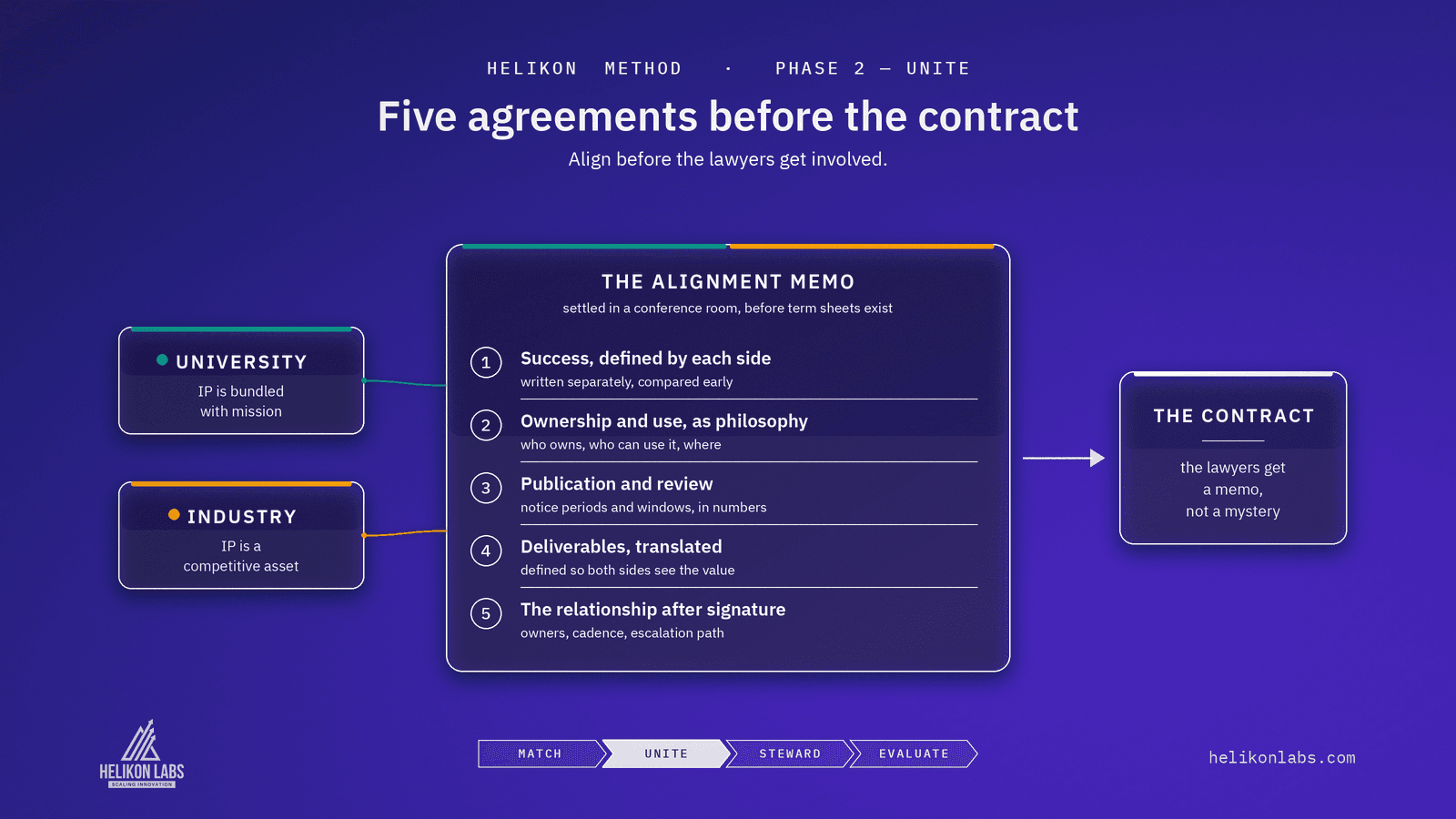
In our Helikon Method terms, this is the heart of the Unite phase. The pattern in partnerships that move forward quickly is consistent: the partners align on substance first, and hand their lawyers a memo instead of a mystery. At least five things belong in that memo.
1. The one-sentence success definition, from each side. Written separately, then compared. Divergence here isn't failure. It's the agenda for the next conversation. Discovering it in a contract markup at month four is the failure.
2. Ownership and use, as a philosophy rather than a clause. Who owns what is created, who can use it where, and what happens to background IP each side brings in. Not in legal language, but in two paragraphs both a professor and a product manager can read and confirm.
3. Publication and review. The university will publish, pretending otherwise wastes a quarter. The real questions are notice periods, review windows, and what redaction rights exist for patentable or competitively sensitive material. Settle the numbers (30 days? 60?) before drafting.
4. The deliverables, translated. Per the translation box above: define each deliverable in terms both sides recognize as valuable, with the format named. "Quarterly technical report" means something different to a lab and to a program office until you write down what it contains.
5. The relationship after signatures. Meeting cadence, named relationship owners on both sides, and the escalation path for the first disagreement, which will come. This is governance design, and it belongs in the pre-legal alignment because it shapes several contract terms (term length, termination triggers, dispute resolution).
One structural note from the corporate side of the table: where a longer relationship is plausible, negotiate the master agreement once and put individual projects under it as statements of work. The first negotiation carries the full weight, everything after moves in days or weeks instead of months. Companies experienced in university partnership do this by default, and universities that propose it early signal exactly the operational maturity that makes industry partners relax.
The cost of skipping alignment at formation
In February 2021, Cisco approached the University of Minnesota with research funding that had to be deployed by April 30. At an institution where a comparable bilateral agreement with a new corporate partner had historically taken six to twelve months, a master research agreement covering all current and future Cisco-funded work was negotiated, signed, and funded in roughly three months, because the alignment work was already done. Minnesota had a pre-negotiated IP option menu (MN-IP Create) and a master agreement template waiting, the institutional version of the five-point memo above. Cisco went on to fund six research projects under that agreement. At the historical pace, the deadline passes months before signature, and none of those projects exist. One deal, at one unusually well-prepared institution. But every month of avoidable negotiation delay sits somewhere on that causal chain, and nobody involved in a stalled negotiation believes the delay is free.
If you want to find out where your operation stands before your next negotiation, start with our free Collaboration Readiness Assessment. It scores agreement and expectation dimensions this article covers. And if your last negotiation ran past six months, the five-point memo above is exactly part of what we build with you in a half-day workshop, or work through one question at a time in Office Hours, for less than the cost of the legal time it's meant to save.
Sources
- UIDP. 2022. "1-Minute Survey: Time to Agreement for U-I Sponsored Research" (n=64). uidp.org · report PDF
- Tran, T., L. Bowman-Carpio, N. Buscher, P. Davidson, J. J. Ford, E. Jenkins, H. N. Kalay, T. Nakazono, H. Orescan, R. Sak, and I. Shin. 2017. "Collaboration in Action: Measuring and Improving Contracting Performance in the University of California Contracting Network." Research Management Review 22 (1). ERIC EJ1134105 · full text · PubMed
- Lawrence, C. E., V. M. Bruce, L. D. Salberg, T. Edwards, C. Morales, M. Palm, and G. R. Bernard. 2023. "Quantitative Assessment of the Impact of Standard Agreement Templates on Multisite Clinical Trial Start Up Time." Journal of Clinical and Translational Science 7 (1): e204. doi.org/10.1017/cts.2023.622
- Ariño, A., and Y. Doz. 2000. "Rescuing Troubled Alliances… Before It's Too Late." European Management Journal 18 (2): 173–182. doi.org/10.1016/S0263-2373(99)00089-4
- University of Minnesota Research & Innovation Office. "Collaboration with Cisco Explores Frontier of Data Technologies." research.umn.edu
- Flowers and Roadman. 2024. "Catalyzing Strategic Partnerships: Digital Transformation of University–Industry Collaborations for Synchronized Innovation." R&D Management Conference, Stockholm.
Related
- The Contract Red Flags Kit, a free workbook of the clauses that most often slow a research agreement, with the balanced position for each.
- How to manage a university-industry research collaboration: the plain guide
- Settling the terms of a new partnership? Our Structuring the Partnership workshop works through governance and the operating model with your team, together with our help.