For investors & advisors
Read the research record before the pitch deck.
One page per researcher: publications by year, patents, a funding history, the people they publish with, and which patents cite their papers. One page per organization, with a company's assignee names rolled up. Free to read, across 500,000+ researchers and 3.3 million granted US patents.
Free plan · No credit card required
The deck cites the three best papers
The record shows the other 40: who they were written with, which grants paid for them, which patents cite them, and whether the same group is still publishing on the problem or moved on four years ago. For a founding scientist or a licensed technology, that's the technical track record with the marketing removed.
Most of it's public. Almost none of it's on one page, and the link from papers to patents has mostly lived behind a patent-analytics subscription.
Use cases
Three things investors and advisors can do here
Map a technology area
Start from a Cooperative Patent Classification (CPC) subclass or plain keywords in the Patents tab. Narrow by assignee, year, and status. Open a patent for the scientific literature it builds on, its inventors (linked to researcher profiles where the platform can match them), and the Espacenet record. The Organizations tab rolls a company's assignee names up to one page, with its owned patents, research areas, and the researchers the record links to it.
Read the walkthrough →Read a researcher's record
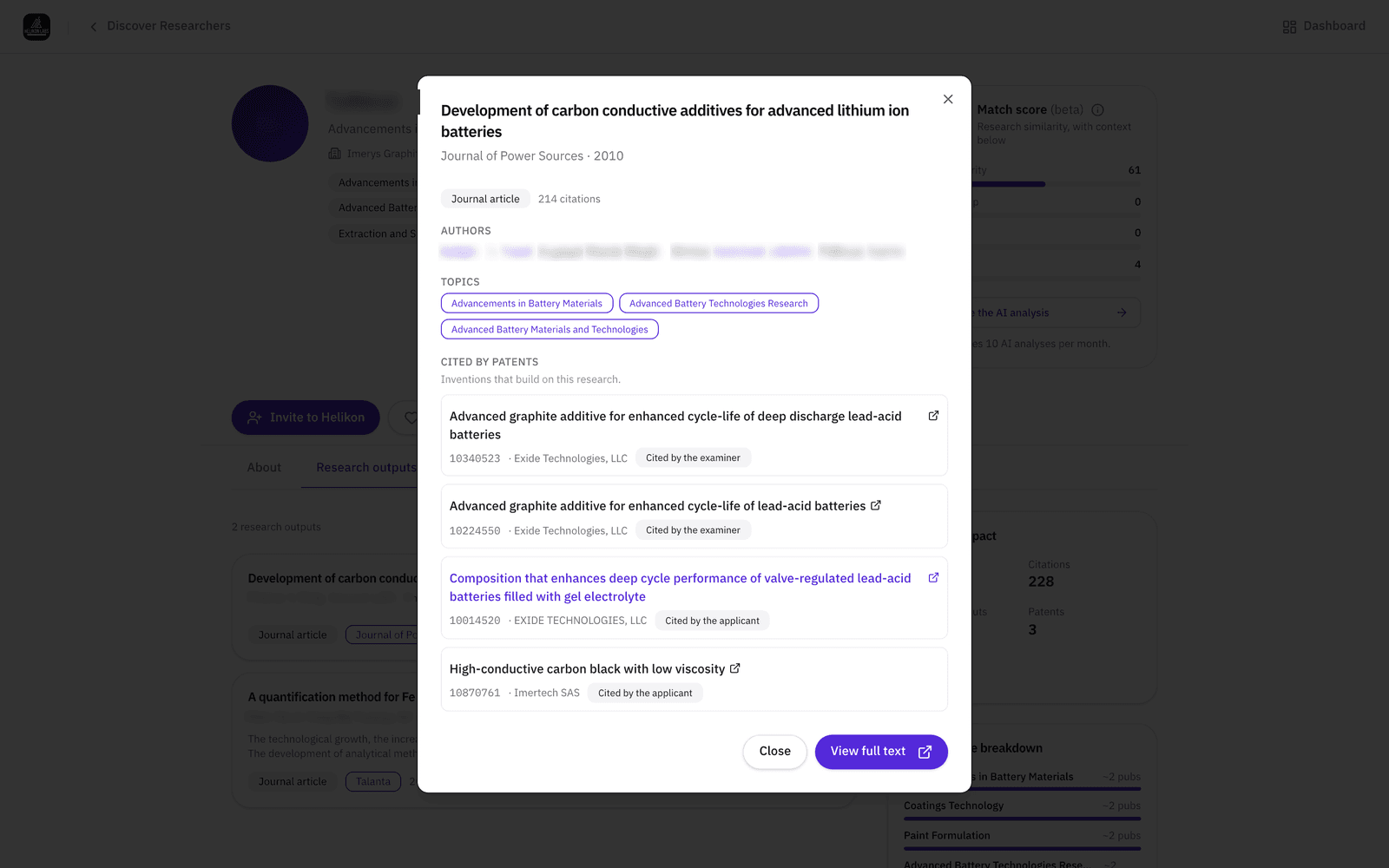
Publications by year, patents linked from the USPTO record, a funding history built from what they've published on, and the people they publish with. Open any paper to see which patents cite it. Where the platform can match an inventor to a profile, the patent and the paper trail sit on the same page.
Read the walkthrough →Follow the people, companies, and technologies you're watching
Follow researchers and their latest papers appear on your dashboard. Save patents, papers, organizations, and people with private notes and tags, so the file on a deal lives somewhere better than a bookmarks bar. With Pro, you can export the saved list to CSV.
Read the walkthrough →Free to read. Pro when the file gets big.
Free covers reading: unlimited searches across researchers, literature, patents, organizations, and funding, plus 50 follows, 50 saved items, and 10 AI collaboration analyses a month. Pro, at $29 a month, lifts saved items to unlimited and follows to 100, adds CSV export of what you've saved, and makes AI collaboration analyses unlimited. Advisors who broker introductions between companies and universities also get the Partnership Pipeline on Pro. No trial, Free is permanent.
Built on our own research
“Catalyzing Strategic Partnerships: Digital Transformation of University–Industry Collaborations for Synchronized Innovation”
Flowers & Roadman (2024). R&D Management Conference, Stockholm. Andrew Flowers, Helikon Labs’ founder, led the study, including a survey of faculty at five R1 universities.
Sources: OpenAlex, USPTO, ROR, Grants.gov, and funder award databases.
Questions investors and advisors ask first
- Is this a startup or deal-flow database?
- No. It's the research record: who published, patented, and was funded to work on a problem, and how those connect. A young company shows up as the assignee name on its granted patents. Once someone from it joins and claims it, its page fills in. The Organizations tab's type badge separates universities, companies, government labs, and non-profits.
- Can I see who funded a researcher's work?
- Yes, from the publication record. The Funding tab lists the awards a researcher has published on, with totals by currency, from US federal agencies and international funders alike. It won't list a grant they never published on.
- Can I share what I find with someone who doesn't have an account?
- Discover search results are shareable by URL, since the filters live in the address bar. A Partner search shortlist is private to your account. Patent and paper panels link out to Espacenet and to the paper's DOI record. Your saved items and notes are private to your account.
Start with the founding scientist's name
Open the profile, read the Funding tab, and open the most-cited paper to see who has patented on top of it.
Free plan · No credit card required