For industry & tech scouts
Scout university research from a problem statement, not a conference badge.
Paste the problem you need solved and get the researchers whose publications, patents, and funding say they have worked on it, matched against 500,000+ profiles. Then run the outreach and, later, the project in the same place.
Free plan · No credit card required
The expert you need has never heard of your company
Corporate tech scouting used to depend on who spoke at the last conference or what a keyword search turns up. A separations team looking for someone who has operated membrane electrolysis at pilot scale can spend a quarter finding three names and another learning which of them has the right background.
The platform starts with your problem statement. It matches researchers on what they've published, patented, and been funded to do, shows you why each one matched, and gives you the messages, meetings, and pipeline to turn an introduction into a partnership.
For a university lab, a publication is the deliverable and career currency, and it needs to be public. In corporate R&D, a paper is a disclosure to be scheduled around a patent filing. A project on the platform names its agreement type on day one, so the “when can we publish?” question gets asked before the first draft exists.
Use cases
Five things scouting teams can do here
Find a research partner from an abstract
Paste a problem statement, a specification, or an internal project abstract (30 to 5,000 characters, and it never appears in a URL or a log). Partner search returns the researchers whose work matches it best, each with a match score and the reason behind it, saved as a shortlist you can reopen. Message a researcher directly, or, from the profile of someone who isn't on the platform yet, send an Invite to Helikon.
Read the walkthrough →Map a technology area
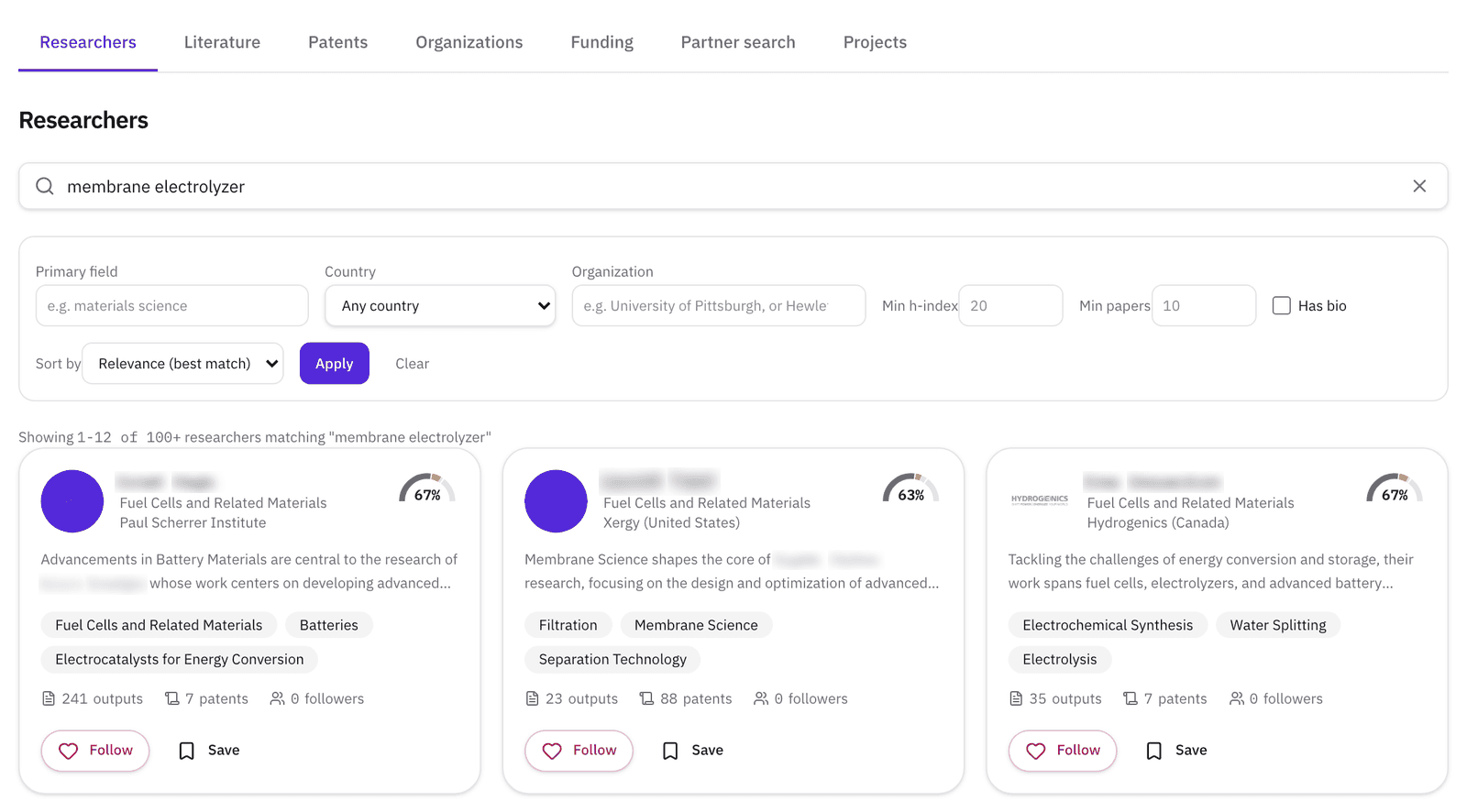
Search the Patents tab for a plain phrase like “membrane electrolyzer” or a CPC subclass, narrow by assignee and year, and open a patent to see the literature it builds on and its inventors, linked to researcher profiles where the platform can match them. Open a paper in Literature to see the patents that cite it, then go to Organizations to see who owns what, with a company's assignee names rolled up to one page.
Read the walkthrough →Manage your partnership pipeline
Six stages, from Lead to Completed. Each card carries the partner, the collaboration type, and a next action with a due date. It links to the researcher, organization, or project behind it, and converts into a project whenever you're ready. Export the board to CSV, or share a read-only view across a Team.
Read the walkthrough →Find a university partner for SBIR/STTR
For startups and small companies writing a Small Business Innovation Research (SBIR) or Small Business Technology Transfer (STTR) proposal. Run Partner search from your specific aims, read a researcher's funding history (including prior awards they published on), and set up the project with the SBIR/STTR agreement type. Add the contract requirement once the subaward is signed.
Read the walkthrough →Run the collaboration in one place
Milestones with owners and due dates, files with a per-file audience, a threaded discussion with @mentions, an activity log, and meetings that send a calendar invite to everyone. The scientist on the other side sees the same record you do.
Read the walkthrough →Applying for SBIR or STTR funding with a university partner? Start with our guide: SBIR and STTR university partners: the rules, how to find one, and what to agree before you submit →
Browse technology areas
Each page counts the researchers, publications, and U.S. patents the Helikon Research Graph holds on one technology, shows who's working on it, and gives you a problem statement to run in Partner Search.
- Additive manufacturing
- Energy storage
- Drug delivery
- Biomanufacturing
- PFAS detection and replacement
- Antimicrobial resistance
- Clean hydrogen
- Chemically recyclable plastics
- Separation membranes
- Semiconductor fab and packaging
- Carbon capture and conversion
- Solar cells
- Robotics
- Autonomous vehicles
- Coatings and adhesives
- Fuel cells
- Bio-based materials and renewable feedstocks
- Cell and gene therapy manufacturing
- Power electronics and wide-bandgap devices
- Biomaterials and tissue engineering
- Industrial AI and digital twins
- AI and computational drug discovery
Free for discovery. Pro for the pipeline. Team for a scouting group.
Free covers: unlimited Partner searches and Discover, 10 AI collaboration analyses a month, 10 new people messaged and 10 Researcher invites a month, and 2 active projects.
Pro, at $29 per month, adds the Partnership Pipeline, unlimited AI collaboration analyses, 200 new people and 50 invites a month, 10 active projects with private visibility, and 5 GB of files.
Team, at $19 per seat per month for 5 to 25 seats and less on annual billing, gives a scouting group a shared pipeline view, unlimited projects, 200 invites a month, 25 GB of files, and the Team analytics dashboard.
Built on our own research
“Catalyzing Strategic Partnerships: Digital Transformation of University–Industry Collaborations for Synchronized Innovation”
Flowers & Roadman (2024). R&D Management Conference, Stockholm. Andrew Flowers, Helikon Labs’ founder, led the study, including a survey of faculty at five R1 universities.
Sources: OpenAlex, USPTO, ROR, Grants.gov, and funder award databases. If a company you care about isn't in the corpus yet, its page is created when someone from it joins, and fills in as they claim it.
Questions scouting teams ask first
- Does Partner search find companies, or people?
- People. It returns researchers, wherever they work, and Show researchers at keeps the list to universities and institutes or to companies. To find organizations, use the Organizations tab (type badge, parent company, owned patents, top research areas) or the assignee filter in the Patents tab. A company's assignee-name variants roll up to one page, and a subsidiary with its own listing shows which parent it's part of.
- Can we keep the problem statement confidential?
- The text you paste into Partner search is never written to a URL, your browser history, or a server log. It's stored with the saved shortlist on your account, and only you can open it. Projects on Pro and above can be private to the people you invite.
- Most of the people we'd want aren't on the platform. Does that matter?
- Less than you'd expect. A researcher's profile exists from the public record before they sign up, so search, match scores, and the citation trail work on day one. An unclaimed profile offers Invite to Helikon in place of Message, and the platform emails the invitation: 10 a month on Free, 50 on Pro, 200 on Team.
Start with the problem statement
Run your first Partner search today. The pipeline is there when the first conversation turns into a prospect.
Free plan · No credit card required