Comparison · Match
How companies find university researchers: Inpart, Halo, FirstIgnite, NotedSource, and Helikon compared
· Last reviewed
Companies find university researchers in four ways. They search the published record for people whose work fits a problem, post a request and read who answers, browse what universities list, or bring in an expert for a paid project. Three of the other platforms here are built around one of those, and the fourth, FirstIgnite, works for the universities. Helikon's search covers the published record itself, members or not, and it's free and unlimited on every plan. You post the work from the same account, and Helikon keeps going after the introduction: the outreach, the agreement, the work, and the reporting, with our consulting team when you want help.
- Helikon takes you from a problem to a working collaboration. Partner Search matches a problem statement against 500,000+ researcher profiles built from the public research record, whether or not the researchers have joined, and each result says what the match came from. Post a project to Discover and researchers can come to you. Then message them, propose meetings, and run the work as a shared project with milestones, obligations, a budget, and a live status report. When you'd rather have help, our consulting team runs the search with you, reviews your shortlist, or trains your team.
- Halo is built around requests. A company posts one, and scientists and startups in its network answer with one-page proposals.
- Inpart is built around its network, and its home page leads with the life sciences. Connect lists technologies and collaboration opportunities from universities and biotechs, and its team runs Campaigns that companies commission.
- NotedSource is a marketplace for hiring outside experts, from advisory calls to sponsored research, with contracts and payments handled on its platform.
- FirstIgnite works from the other side of the table. It helps universities find companies and contact them.
How do they compare?
| Built for | How you find researchers | Who you can find | What you see before you reach out | Getting in touch, and after | Cost to a company | |
|---|---|---|---|---|---|---|
| Helikon | Companies, researchers, and research offices, from finding a research partner to running and reporting on the collaboration | Paste a problem statement, abstract, or project summary into Partner Search, and keep the results to universities and institutes if you like. Search researchers by field, country, or organization. Or post a project to Discover, and researchers who find it express interest | 500,000+ researcher profiles built from the public research record, members or not, at universities, institutes, and companies | What each match came from (publications, patents, or bio), and each researcher's papers, patents, the patents that cite their papers, and the awards their papers credit. An AI collaboration analysis of the fit | Message members, invite anyone else by email, and propose meetings. Save a shortlist with notes, track partners in a pipeline on Pro, and run the work as a shared project with milestones, obligations, and a budget, and report on it with a live quad chart. Our consulting team can run the search for you and help structure, run, and measure the partnership | Free, with unlimited partner searches and free project posting. Pro is $29 a month billed monthly, and Team $19 a seat a month for 5 to 25 seats. Office Hours and workshop prices are on our site |
| Inpart | R&D and business development teams, universities, and biotechs. Its home page names 500+ clients across the life sciences industries | Build an interest profile and get matched with research and technologies. Or commission a Campaign, and Inpart's team writes it up and screens what its network sends | Its network: 21,000+ verified members and 3,000+ universities and research institutes, says its network page | Technologies and collaboration opportunities that institutes and biotechs list. A Campaign report regularly holds 50 to 100 opportunities | In-house science experts make introductions and follow up. Deal, a separate CRM for biopharma partnering, covers intake through alliance management | Free to join. Paid options add Campaigns, with the fee paid upfront and no success fee |
| Halo | R&D teams looking for scientists, startups, and suppliers | Post a request, or search the network. Halo says its matching and scouting use AI, with matches in minutes | Its network: 20,000+ innovators in 150+ countries, says its home page | One-page proposals from the people who respond, with tools that help a distributed team sort the most promising | Invite partners to connect or submit proposals, with or without your company's name | A free account. Halo says it charges sponsors to post opportunities |
| FirstIgnite | University, hospital, nonprofit, and foundation partnership teams looking for companies and funders | Not a company tool. Its Prospecting, AI Agents, and CRM help a university find companies like yours | AI agents that, it says, personalize outreach, manage follow-ups, and schedule meetings for the university | |||
| NotedSource | Companies bringing in outside experts for R&D, from advisory calls to sponsored research | Describe the problem and get matched with vetted experts, "people first, AI throughout." Its Research Agent gives cited answers from 400M+ sources and finds the experts and labs behind them | 50,000+ vetted experts, from academic researchers to labs, startups, and industry specialists, says its home page | Its Collaboration Hub handles contracts, NDAs, IP terms, and payments, with NDA and IP terms on every engagement, and tracks project activity and spend |
The table draws on each vendor's own pages: Inpart's home, Connect, network, Campaigns, and Deal pages, Halo's home, industry, and help center pages, FirstIgnite's About and Prospecting pages, and NotedSource's home and Find experts pages. A blank cell means the vendor's own pages didn't say, when we checked on 30 October 2026. Counts are each vendor's own, as its pages showed them that day. None of the four showed a price for companies on the pages we read.
How do you find researchers from a problem you can describe?
Describe the problem in your own words, then search the published record for the people whose work fits it. A scout rarely knows the right names at the start, which is why a name search or a university directory usually comes second.
On Helikon, Partner Search takes a problem statement, an abstract, or a project summary, from a few sentences up to 5,000 characters, and matches it against each researcher's bio, publications, and patents. The closest come back first. Each card says whether the match came from the publication record, the patent record, or the bio. It also gives a percentage for the closest single part of that researcher's record. Show researchers at keeps the list to universities and institutes, or to companies.
The screenshot below shows a Partner Search for a polymer recycling problem, with the results kept to universities and institutes.
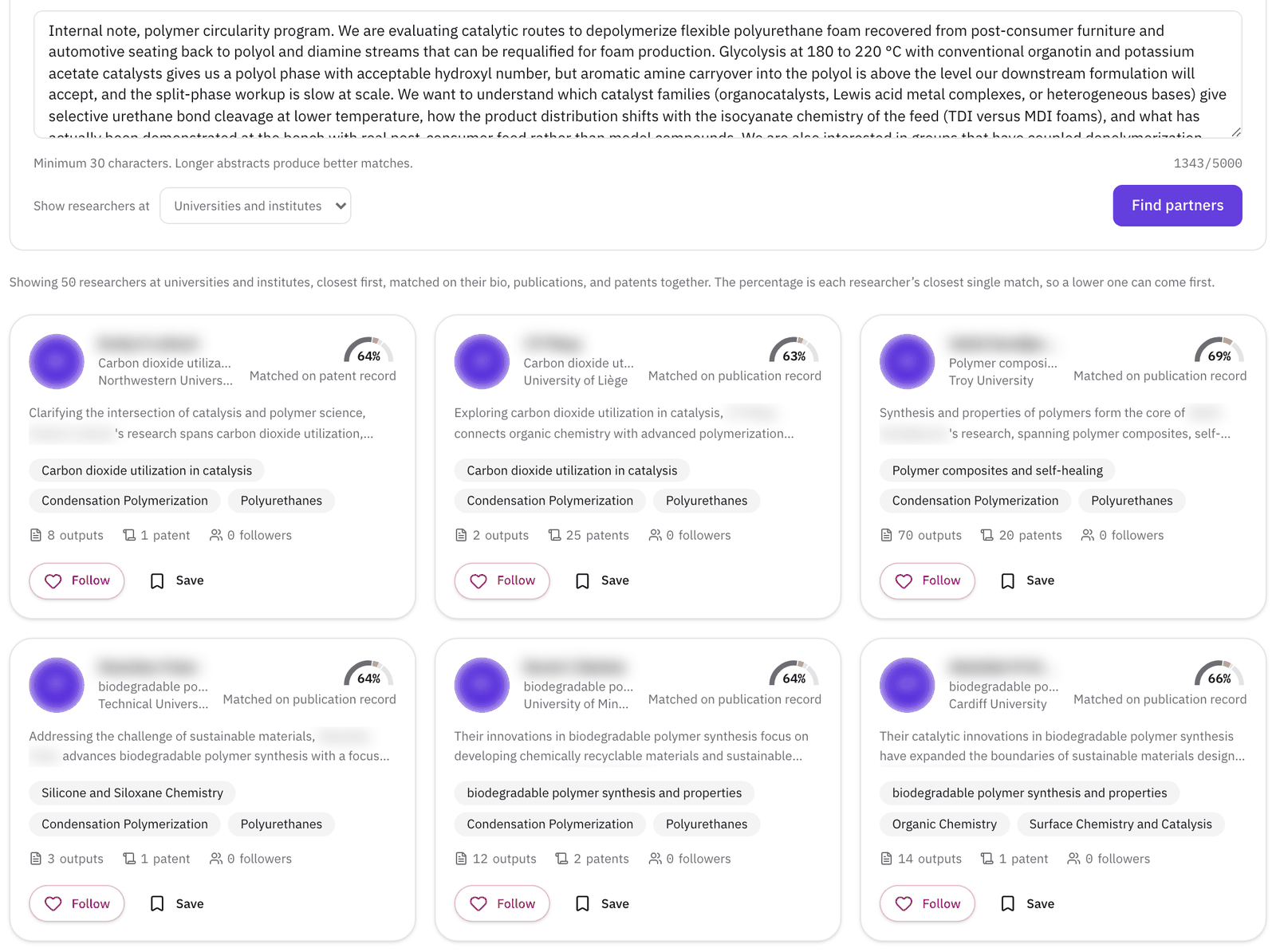
Three details matter to a company. What you paste stays out of the page's address, and researchers aren't told you searched. Each search keeps its results as they were, so the list you come back to next week is the one you saw today. And partner searches are unlimited on every plan, Free included.
Search for people, not only for institutions. In D'Este and Patel's survey of UK academic researchers, the individual researcher's characteristics had a stronger effect on how they worked with industry than the characteristics of their department or university (Research Policy, 2007). The same study found that researchers work with companies through consulting, contract research, joint research, and training more often than through patents or spinouts.
If you already know the university, its organization page on Helikon lists its most active and most cited researchers, plus its publications and patents. A second tab puts the closest matches to your profile first. The university's corporate relations office can also make an introduction, and in our experience it helps to arrive with two or three names.
Startups applying for SBIR or STTR. Paste your specific aims page into Partner Search to find a university partner (how), and search past SBIR and STTR awards by topic to see which universities partnered on work like yours. Both work on every plan, Free included.
What if you'd rather researchers came to you?
Post the work, and let the people who fit it find you. It's worth doing when you don't know which field holds the answer, or when you'd like researchers to bring you ideas.
On Helikon, that's a project. Describe the work, add the expertise you're looking for, and set the project's visibility to Everyone. It then appears in Discover → Projects, where members filter by collaboration type, required expertise, and organization, and in other members' dashboard suggestions. A researcher who finds it expresses interest with a note, and you or an admin on your project accept or decline. You don't have to wait to be found, either. The project recommends researchers whose work fits its description and the expertise you asked for, from the whole research record, members or not, so you and your project's admins can invite them yourself.
Posting a project is free on every plan, Free included. Once the right people say yes, the same project runs the collaboration, so nothing has to move to another tool. Our walkthrough Staff a funded project shows each step.
Two of the other platforms here are also built around requests.
Halo
On Halo, you post a request or search its network, and you can invite partners to connect or submit proposals, with or without your company's name. Scientists answer with a one-page proposal, and Halo's tools help a distributed team sort the most promising (Halo for industry, Halo for innovators). Halo is free for universities, scientists, and startups that submit proposals, and it charges sponsors to post opportunities (Halo help center). Its marketplace lists 400+ open requests, which you can filter by expertise, partnership type, and partner eligibility (Halo).
Inpart Campaigns
An Inpart Campaign is a search you commission. Inpart's team helps you refine the focus and writes a one-page summary of the campaign. Researchers and companies in its network submit, and Inpart's research team reviews the responses against your criteria and sends a report. Inpart says its reports regularly hold 50 to 100 opportunities. It says clients engage about 15% of the opportunities in a report. It also says clients usually review within six to eight weeks. The fee is paid upfront, with no success fee, and a Campaign can name your company or not (Inpart).
Search and post together
A request reaches the people who see it and choose to answer. A search finds the people whose published work fits, including many who'd never see the request. On Helikon you do both. The search covers 500,000+ researcher profiles, members or not, and the project you post recommends researchers from the same record, so you can invite the ones your post hasn't reached.
If you'd rather not run the search yourself, our Managed Partner Search and Setup sprint runs it for you. Where a Campaign collects responses from the people in a network who choose to answer, Managed Partner Search starts from the whole published record. We find candidates with the platform's matching, evaluate them with our Partner Evaluation Scorecard, and run the outreach through to first meetings. Then we hand the search over to your team, and you keep the relationships. It's a fixed scope at a fixed fee, and sprint prices are in our free consulting guide.
What if you need an expert for a short paid project?
Find them the same way, by the problem, and work with them directly. On Helikon, message or invite the expert, propose a meeting, and run the work as a shared project. For paid advice, start from the Consulting Agreement template, which begins with the institution's rules on outside work and a clear scope, then sets up the deliverable and the final invoice. For work through the university, start from Sponsored Research (Industry) instead, file the signed agreement, record the NDA and the contract with their expiry dates, and set the milestones, obligations, and budget (Set up an industry-sponsored project). Ask early which of the two it is, because the university handles them differently. If you'd like a second opinion before you commit, our Office Hours are hourly advisory you can book with us.
NotedSource is a marketplace built around paid engagements. You describe the problem, and it matches you with experts from what it describes as a vetted network of 50,000+ researchers, labs, startups, and industry specialists (NotedSource). Engagements run from advisory calls and technical reviews to long-term sponsored research. Experts set their own rates, and its Collaboration Hub handles contracts, NDAs, IP terms, and payments, with milestone payments released on sign-off (NotedSource, NotedSource for experts). Its Research Agent answers questions with citations from 400M+ sources and finds the experts and labs behind them.
Where does FirstIgnite fit?
On the university's side of the table. FirstIgnite builds software that helps universities, hospitals, nonprofits, and foundations find and engage partners and funders. Its Prospecting tool matches a university's research to companies. Its AI agents personalize outreach, follow up, and schedule meetings, and its CRM tracks the relationships (FirstIgnite, FirstIgnite Prospecting).
If your company gets a well-targeted email from a university's technology transfer or corporate relations office, it may have come through a tool like this. Answer the outreach that fits, and when you'd rather lead the search yourself, start from your problem on Helikon.
What should you check before you contact a researcher?
Whether they've worked with industry before, who has funded them, and whether anyone has built on their work. Bruneel, D'Este, and Salter found that prior experience of collaborative research lowers the barriers that come from the two sides' different orientations. Greater trust lowered both kinds of barrier they studied (Research Policy, 2010).
A Helikon profile answers those questions on one page.
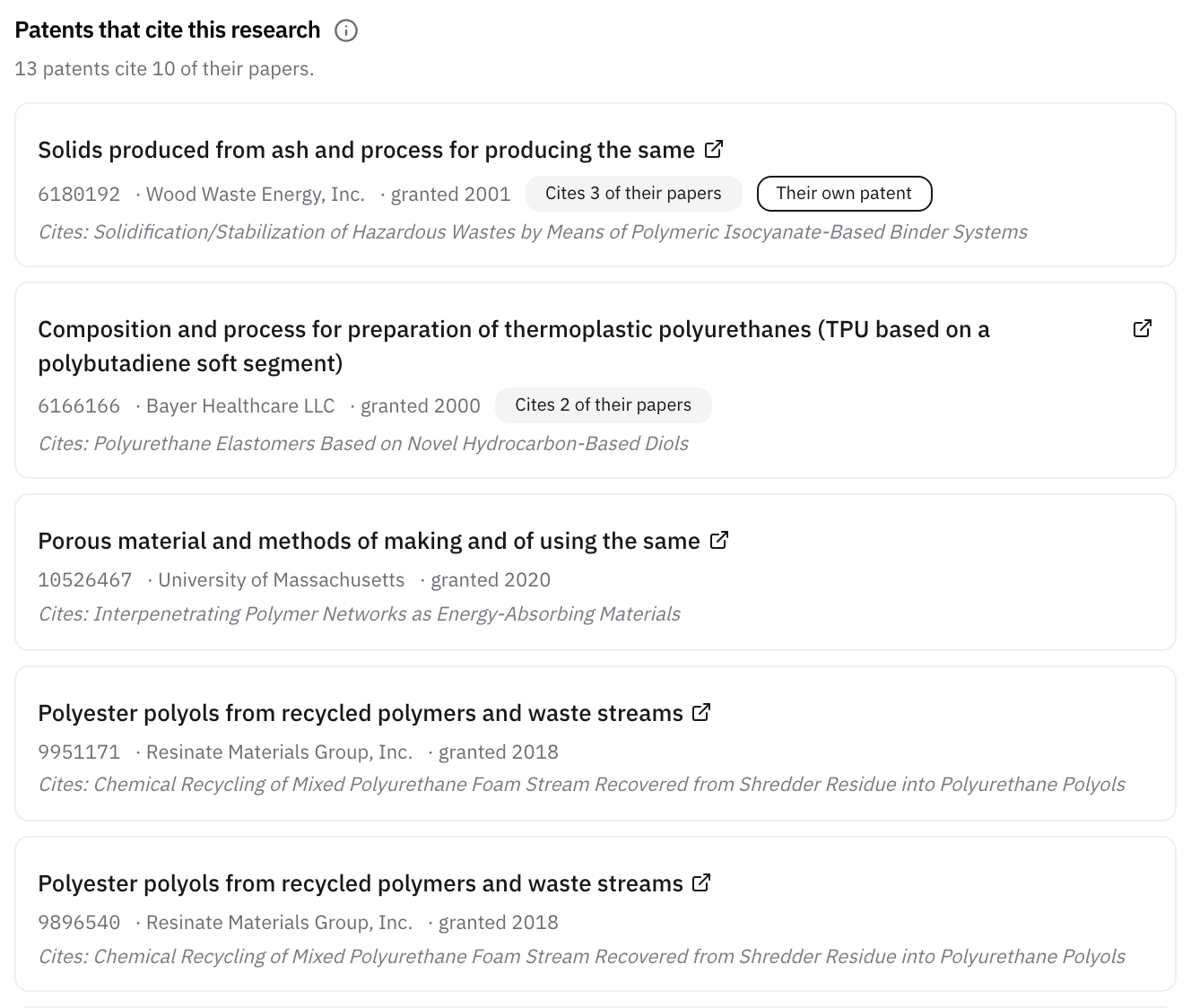
- Patents, and the patents that cite their papers. The Patents tab lists the patents a researcher holds and the patents that cite their papers, each with the company or university that owns it.
- Funding. The Funding tab lists the awards a researcher's papers credit, with the ones they led marked and a filter for SBIR and STTR awards, so you can see who has paid for their work.
- Fit with you. The Match score panel compares their work with your profile. The AI collaboration analysis writes up the pairing: how strong the fit is, what each side brings, the ground you share, and what to check first.
- What they're open to. Members say on their profile which kinds of collaboration they're open to, such as sponsored research or licensing.
The screenshot below shows the first of those checks in practice: the patents that cite one researcher's papers, on their profile's Patents tab.
To compare a shortlist the same way every time, our Partner Evaluation Scorecard scores up to four candidates on eight weighted criteria and writes a decision memo for your selection committee. Our article How to evaluate a research partner: fit beats prestige explains the criteria. To work through a search and a shortlist with your team, our half-day Partner Discovery and Selection workshop includes the scorecard. And in Office Hours, we'll review your shortlist with you before you reach out.
Which claims should you take with a grain of salt?
Every platform here, ours included, leads with large numbers, so read them carefully.
- Network counts change from page to page. Inpart's Connect page says 2.6K academic institutes, and its network page says 3,000+ universities and research institutes. Its Campaigns page separates 250+ subscribed research institutes from a wider network of 2,600+, so ask which group a Campaign reaches (Connect, network, Campaigns). NotedSource's 50,000+ is "vetted human experts" on its home page, "Vetted Experts & Labs" on its page for experts, and "researchers" on its About page (NotedSource). Halo's home page doesn't say what its 90,000+ "solutions" are.
- Ask what an AI match reads. Halo says its matching uses AI, and NotedSource describes its approach as people first, with AI throughout. Neither page says which parts of a researcher's record the matching reads. Inpart says Connect uses natural language processing and supervised machine learning to match biotech assets with biopharma (Inpart). Ask before you rely on a match. On Helikon, every result says whether it came from the researcher's publications, patents, or bio, and How to find research collaborators from an abstract explains what the percentage measures.
- Outcome figures without a baseline. FirstIgnite's home page reports 3× more partnerships and a 350% increase in email outreach after a year, without saying compared with what or across how many customers (FirstIgnite). Inpart's Connect page counts 16K partnering conversations, and its platform page calls them new conversations started, without saying how many led to an agreement (Connect, Inpart). Its Campaigns page gives a more useful figure: clients engage about 15% of the opportunities in a report. That's the kind of figure worth asking every vendor for.
- Ours too. Our 500,000+ is researcher profiles built from the public research record, not sign-ups. That's why every match says what it came from, and the papers and patents behind it are on the profile.
How does Helikon cover a collaboration from the first search to the final report?
Helikon is one account for the whole collaboration, built around the four phases of The Helikon Method, our framework for university-industry partnerships. The platform does the daily work in each phase, and our consulting team, with experience across the R&D-to-commercialization lifecycle, is there when you'd rather not do it alone.
- Match: find the right people, members or not. Partner Search covers 500,000+ researcher profiles, with 34 million publications and 3.3 million patents behind them, and every result says whether it came from the researcher's publications, patents, or bio. Post a project, free on every plan, and members who find it express interest, while the project recommends researchers whose work fits it. Each profile puts the papers, the patents, the patents that cite their papers, and the funding on one page. With us: Managed Partner Search and Setup, or the Partner Discovery and Selection workshop.
- Match: know whether a match is worth a first call. The AI collaboration analysis makes the case for each pairing before you spend an hour finding out. It gives a verdict, from strong fit to not recommended, says what each side brings and where your work meets, and lists what to check before you reach out. It calls a weak fit or a keyword coincidence what it is, so a long shortlist narrows to the few people worth contacting.
- Unite: agree how you'll work. Save researchers with notes and tags, message members, invite anyone else by email, and propose meetings. Track partners through six stages in the Partnership Pipeline on Pro, shared on Team. Start the project from one of 45 agreement templates, from sponsored research to a consulting agreement, and record the NDA, IRB approval, and contract with their expiry dates. With us: the Structuring the Partnership workshop.
- Steward: run the work. Milestones, obligations such as publication reviews and sponsor reports with their due dates and reminders, and a budget, in a project the whole team shares. With us: the Stewarding the Partnership workshop, or Office Hours for a second opinion.
- Evaluate: report and decide. A live quad chart built from the project's own records, the one-page summary sponsors expect, phase-gate decisions on record, and, on Pro, a saved and approved status report for each reporting period. With us: the Measuring Partnership ROI and Impact workshop.
- Prices you can see. Free to start, with unlimited partner searches and free project posting. Pro is $29 a month billed monthly, and Team $19 a seat a month for 5 to 25 seats (pricing). Office Hours and workshop prices are on our site, and sprint prices are in our free consulting guide.
Where should you start?
Write two or three sentences on the problem: what you're trying to do, what's in the way, and the kind of partner you need. Then:
- Paste it into Partner Search on Helikon, set Show researchers at to universities and institutes, and save the five or six researchers whose work comes closest.
- Before you write, check each one's patents, the patents that cite their papers, and their funding. With your own profile filled in, run the AI collaboration analysis on your top two or three. It compares their work with yours.
- Message the members and invite the others, with a short note on the problem and what you'd like to talk about.
- Post the same problem as a project visible to everyone, with the expertise you need, so the researchers your search didn't reach can come to you.
- If you'd like a second opinion on your shortlist, book Office Hours. If you'd rather we ran the search, book a free 30-minute scoping call.
What if you're a researcher or a research office?
Researchers. On Helikon, there may already be a profile of your work built from the public research record, so companies searching a problem can find you. Claim it, and say which kinds of collaboration you're open to. You can import your papers by ORCID iD, author name, OpenAlex ID, or DOI, and your patents by patent number or inventor name. Then browse Discover → Projects for the projects companies and other members have posted, and express interest in the ones that fit.
Research offices. Partner Search works from your side too: paste a technology summary, set it to companies, and see the industry researchers whose work comes closest. The Team plan gives an office of 5 to 25 people one shared Partnership Pipeline, and each agreement you sign can run as a project with its milestones, obligations, and budget. When the office is stretched, our Managed Partner Search and Setup sprint finds and evaluates the companies for you and runs the outreach through to first meetings (For research offices).
Sources
- Inpart, home page. www.inpart.io/
- Inpart, Connect. www.inpart.io/products/connect
- Inpart, Network. www.inpart.io/network
- Inpart, Campaigns. www.inpart.io/network/campaigns
- Inpart, Connecting. www.inpart.io/platform/connecting
- Inpart, Deal. www.inpart.io/products/deal
- Halo, home page. www.halo.science/
- Halo, For innovators. www.halo.science/innovators
- Halo, For industry partners. www.halo.science/industry
- Halo, Marketplace requests. www.halo.science/marketplace/requests
- Halo help center, Does Halo charge universities or scientists?. knowledge.halo.science/does-halo-charge-universities-or-scientists
- FirstIgnite, home page. firstignite.com/
- FirstIgnite, About us. firstignite.com/about-us
- FirstIgnite, Prospecting. firstignite.com/products/prospecting
- NotedSource, home page. notedsource.io/
- NotedSource, Find experts. notedsource.io/find-experts/
- NotedSource, Our expertise network. notedsource.io/our-expertise-network/
- NotedSource, About us. notedsource.io/about-us/
- D'Este, P., and Patel, P., 2007, University-industry linkages in the UK: what are the factors underlying the variety of interactions with industry?, Research Policy 36(9), 1295-1313. doi.org/10.1016/j.respol.2007.05.002
- Bruneel, J., D'Este, P., and Salter, A., 2010, Investigating the factors that diminish the barriers to university-industry collaboration, Research Policy 39(7), 858-868. doi.org/10.1016/j.respol.2010.03.006